Who We Are
HERITAGE OF PUSA
The history of Pusa is age-old, which has the roots in the Darbhanga Raj of Tirhut Estate wherein 18th century after the victories of the British East India Company in the Battle of Plassey (1757) and the Battle of Buxar (1764) followed by the Treaty of Allahabad (1765), the imperial government acquired the U-shaped land of Pusa near the right bank of the Burhi Gandak River in 1796. Later on East India Company established a stud farm at Poosah (Pusa), led by Lieutenant Major Frazer (Superintendent, 1793-1808) to breed cavalry horses. This endeavour continued until 1874 but was closed due to an epidemic of gland disease. The Bengal government owned a sprawling estate at Pusa, where it had earlier run a model farm from 1875 to 1876. It was subsequently leased out to the British tobacco firms for experiments on tobacco culture from 1877 to 1897 to meet the requirements of UK cigarette factories.
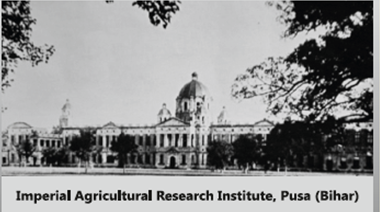
Pusa is a place of pilgrimage for agricultural researchers and academicians in India because it is the place where organized agricultural research and education began in pre-independence India on April 1,1905, when it was established as the “Imperial Agricultural Research Institute (IARI)”. Initially, the “Phipps Laboratory” was constructed after generous donation of £30,000 in 1903 to the Agricultural Research Institute (ARI) by the Mr. Henry Phipps, an American philanthropist. Further, a grant of £110,000 by the colonial government resulted in the development of different infrastructural facilities, including the “Navlakha Building”. In 1911, the name of ARI was changed to the “Imperial Institute of Agricultural Research,” and in 1919, it was renamed “Imperial Agricultural Research Institute (IARI).” However, a devastating earthquake in January 15, 1934, led to the institute’s relocation to Delhi on July 29, 1936, and it acquired its current name, “Indian Agricultural Research Institute (IARI),” after the independence of India in 1947. Since then, this institute has been continuously in the service of India and has made many significant achievements in agriculture, making India a food surplus and nutritionally secure country.

Hence, IARI, Pusa, Samastipur (Bihar) is the birth place of Agricultural Research and Education in India wherein 1923, the first post graduate programme in agricultural education was started and today it’s a centenary year of that wonderful prestigious initiation. Since, 1794 Pusa has been epicenter of agricultural and animal husbandry related economic activities in one form or other that can be traced back in many historical documents of that period. Therefore, it can be safely concluded that name of Pusa is not based on the name of Philanthropist Mr. Phipps from United State of America (USA) which is otherwise general perception and belief but it is not true. In fact, historically Pusa was existing long before the generous contribution made by the Henry Phipps of USA and can be found into the “Rigvedas 10th sloka devoted to deity Pooshan” “पूषा॒ गा अ॒वतु॑ नः पूषा॒ रक्षि॑ता रिव॑तः।
पूषा॒ वाजं॑ सनोतु नः।” ॥५॥sukt 6.54.5.” and also in the 16th sloka of “Eshavaashopnishad” which is one of the reputed embodiments of holy knowledge book.
ABOUT RPCAU
Dr. Rajendra Prasad Central Agricultural University (RPCAU) an Institution of
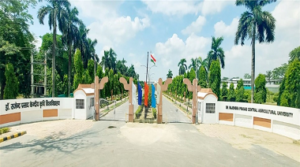
National Importance, was established on 7 October, 2016, owes its legacy to Rajendra Agricultural University, Pusa (1970) and Agricultural Research Institute, Pusa (1905), where higher agricultural education at Post Graduate Diploma in India was initiated in four disciplines- Botany, Agricultural Chemistry, Mycology and Entomology is considered to be the mother of organized agricultural research and education in India. The jurisdiction and responsibility of RPCAU, Pusa with respect to teaching, research and extension education is extended to the whole country with special reference to the state of Bihar.

ACADEMIC
The academic set up of the university comprises of 08 colleges viz. Tirhut College of Agriculture, PG College of Agriculture, College of Agricultural Engineering and Technology, College of Community Science, College of Basic Sciences and Humanities, College of Fisheries and Pt. Deen Dayal Upadhyay College of Horticulture and Forestry, School of Agri Business & Rural Management. University offers under-graduate (UG) programme in 08 disciplines viz. Agriculture, Horticulture, Agricultural Engineering, Community Science, Fisheries, Biotechnology, Forestry and Food Technology. In addition, Master’s programme in 27 subjects and Ph.D. programme in14 subjects are also offered by the university. RPCAU is a multicampus university having three campuses, at Pusa (Samastipur), Dholi (Muzaffarpur) and Piprakothi (East Champaran), 18 KVKs (16 under its direct control and 2 under technical control) and 4 research station spread over an area of 2063 acres comprising of lakes, ponds, wetlands, farm land, and arboreal coverage supporting rich flora and fauna, having a rich biodiversity. In light of new National Education Policy, University has started eight (8) Certificate course programmes and three (3) PG Diploma courses to generate industry ready personnel at base and supervisory level. In view of the expanding influence of the University over education in agricultural sciences, the faculties and facilities have been upgraded and modernized to serve the students better. However, despite its modern outlook, the University is still preserving its legacy and to showcase it, fourteen old bungalows and some residential quarters are still maintained to display their imperial touch. The University envisions providing value-based education and not restricting itself to merely imparting technical education.
RESEARCH
On research front, the University has released 18 varieties of rice, wheat, sugarcane, coriander, millet, maize, pulse, tuber crops and mushroom through CVRC/SVRC for different agro climatic conditions. Has developed technologies for different socio-economic groups and challenged ecology (12), value addition of the agricultural produce and advancement of scientific knowledge through 32 AICRP, 03 International Projects, 4-Govt. of India funded projects, 04 Govt. of Bihar funded projects and more than 100 University funded projects. RPCAU has established many Advanced Centres for Research and Centres of Excellence to take the research challenges in niche areas/ crops, like up- gradation of Banana Research Centre at Goraul (Vaishali), Centre of Excellence/Advance Studies in Water Management, Climate Change, Food Processing, Embryo Transfer Technology, Mushroom Technology, Indigenous cattle conservation, wealth from waste, startup facilitation center to facilitate entrepreneurs to take up business activities in the areas related to agriculture and allied activities.The university has successfully conceptualised and translated the idea into revenue generation through monetization of agro waste viz. herbal gulal, mushroom products, mosquito repellent from dry turmeric leaf, textile fibre from banana pseudo stem, jaggery products and Balshakti. The University has addressed the concern of waste disposal not only in its campuses but also in the temples of Vaidyanath Dham, Deoghar (Jharkhand) and Baba Garib Nath temple, Muzaffarpur by converting the floral waste of these temples into vermicompost which not only strengthened the Swatch Bharat Abhiyan but also helps in generating revenue to the tune of Rs 16 lakhs / annum. Recently, the University has received patents for two products developed by our scientists, namely, Self-Propelled Rotary Power Paddy Weeder and Hand Cranked Improved Chakki. Highly impressed by the workflow of the waste management model of Sukhet, Hon’ble Prime Minister stressed upon the need of replicating it at every Panchayat of the country in the 80th edition of “Mann Ki Baat”.
EXTENSION
The University is making sincere efforts for ensuring food security to the masses, reducing poverty and protecting the environment through transfer of agricultural technologies among the farmers and other users. The university undertakes extension activities through the Directorate of Extension and KVKs under its control. It provides on and off campus training programmes, field level demonstrations, on farm trials, Kisan Melas, formation of farmers groups and developing seed villages etc. for practicing farmers, rural youth, extension functionaries, Govt. officials and other stake holders. The university has 16 KVKs under its direct administrative control and 2 KVKs under its technical control. Five new KVKs were established during the last five years in larger districts.
ACHIEVEMENTS
Vision
- Augmenting/Advancing professional competency for pursuing excellence in agriculture and allied education, research, and entrepreneurship with ethical values to meet the Regional, National and Global needs and offering specialized services to the farmers for decent livelihood
Mission
- Promote experiential high quality learning environment and creation of integrated approach that develops an appreciation and understanding of the socio-economic and environmental significance of soil-plant-animal-people interface.
- Shaping agricultural stakeholders into self-sustaining mode through innovative centric education, cutting edge research, entrepreneurship/ start up skill development and dissemination of appropriate agricultural technology.
- Nurture national/ global needs of sustainable food production through advance interventions of research and development.
- Making Eastern India agriculture climate resilient and mitigating pressure on agricultural land through higher productivity.
Goals
- To improve the quality of education, research, and extension by creating a sound, intellectual and hardworking manpower in agriculture and allied fields at par with the national/international institutes.
- To undertake basic, strategic, and applied research for developing technologies to enhance productivity and quality of agricultural and animal produce.
- To improve the nutritional standard and quality of life of the people through the promotion of sustainable development in agriculture sector.
- To provide an integrated outreach to meet the agricultural needs of the country with special reference to Bihar and to act as a link between the university scientists and farming community as well as allied industries.


Users Today : 402
Total Users : 4530701